


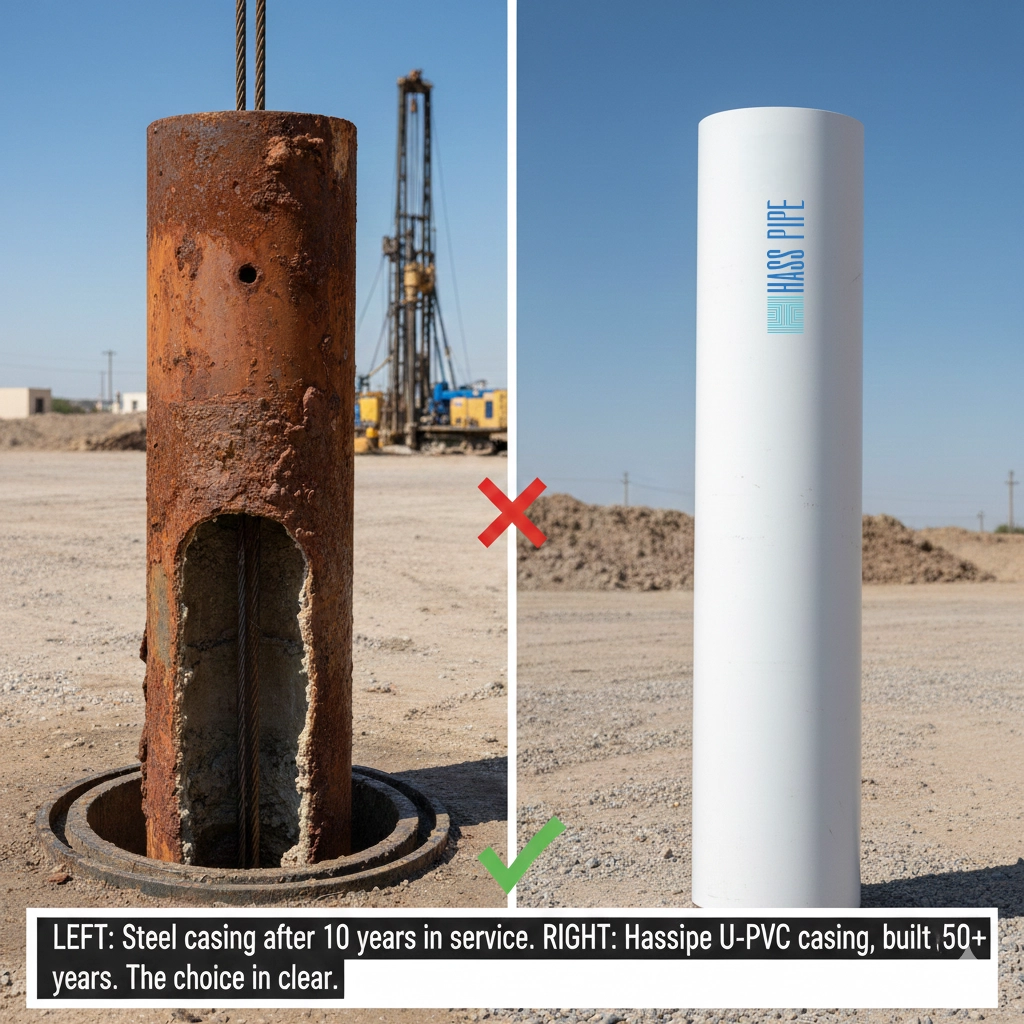
When investing in a deep well project, choosing the right pvc well casing or steel pipe determines the long-term success and water quality of your borehole. Well casing pipe is the crucial structural liner designed to prevent borehole collapse and facilitate groundwater extraction. While steel was the traditional choice for decades, U-PVC (Unplasticized Polyvinyl Chloride) has become the global standard for professional groundwater extraction. Offering a lifespan of over 50 years, U-PVC is 100% immune to the electrochemical corrosion that routinely destroys metal pipes. This guide examines why U-PVC well pipe is the superior investment by comparing corrosion resistance, hydraulic performance, and overall installation costs.
What is the Best Material for Well Casing
U-PVC is the best material for well casing because it offers complete immunity to electrochemical corrosion, unlike steel which oxidizes over time. With a 50+ year lifespan, this lightweight polymer delivers superior longevity and water purity for deep well projects.
Steel well casings typically only last 15-25 years before succumbing to the chemistry of the earth, while U-PVC guarantees 50+ years of reliable use. For decades, steel was the traditional material choice. However, metal inevitably rusts when in contact with soil minerals and groundwater. By utilizing an inert polymer framework, U-PVC well pipe eliminates these structural vulnerabilities entirely, making it the safest long-term investment.
Why U-PVC Outperforms Steel Well Casing
Corrosion Resistance and Water Purity
U-PVC outperforms steel in corrosion resistance because it is a polymer that is 100% immune to rust, scaling, and pitting. This chemical inertia ensures that groundwater remains completely pure without any iron oxide leaching into the system.
Steel pipes frequently leach iron oxide (rust) into the water supply, heavily affecting its quality and potentially damaging industrial filtration systems. Absolute corrosion resistance is critical for both agricultural irrigation and industrial water use. Hasspipe U-PVC well pipes are non-toxic and do not react with groundwater, preserving the natural purity of the aquifer.
Hydraulic Performance and Flow Efficiency
U-PVC provides higher flow efficiency than steel due to its significantly lower friction coefficient. This “hydraulic smoothness” minimizes water resistance, allowing well pumps to deliver higher flow rates using less electricity.
Unlike steel, which develops rough internal surfaces over time due to rust, U-PVC prevents the buildup of scale that narrows the pipe diameter. Water flow efficiency is a critical factor in reducing ongoing pump energy costs. Because the interior of U-PVC remains smooth indefinitely, its flow efficiency remains exceptionally high, whereas steel’s efficiency continually decreases over time.
Installation and Total Cost of Ownership
The total cost of ownership for U-PVC is much lower because the material is significantly lighter than steel, making transportation and installation cheaper. Once installed, U-PVC requires zero maintenance and no anti-corrosion treatments.
Using lightweight U-PVC drastically reduces the need for expensive, heavy-duty machinery on the drill site. Heavy steel pipes drive up initial transportation and installation expenses significantly. In contrast, U-PVC saves thousands of dollars in long-term maintenance by eliminating the need for frequent pipe replacements. In short, the lightweight nature and zero-maintenance requirements of U-PVC make it the most cost-efficient choice for modern boreholes.
U-PVC vs Steel Well Casing Comparison
Comparing U-PVC and steel well casing reveals that U-PVC is superior across all measurable attributes, including corrosion resistance, lifespan, and flow efficiency. The following table highlights the core differences between the two casing materials:
Feature | U-PVC Well Casing | Steel Well Casing |
Corrosion Resistance | Excellent (Immune) | Poor (Requires Coating) |
Lifespan | 50+ Years | 15-25 Years |
Weight | Lightweight (Easy Install) | Very Heavy |
Flow Efficiency | High (Smooth Interior) | Decreases Over Time |
Total Cost | Low | High |
Specialized Depth Solutions by Hasspipe
Hasspipe offers specialized U-PVC well casing series tailored to specific geological demands, effectively serving depths ranging from 100 meters to 300 meters. These systems utilize solvent cement socketed pipes for permanent, leak-proof bonding.
The 100 Meters Series provides an economical and reliable solution for shallow-to-medium irrigation wells. Conversely, the 300 Meters Series delivers heavy-duty collapse resistance required for deep industrial boreholes. Implementing solvent cement socketed connections creates structural integrity that heavily surpasses traditional threaded pipe connections.
Is PVC or steel better for well casing?
PVC is significantly better for well casing because it offers 100% immunity to electrochemical corrosion and lasts over 50 years. Steel inevitably rusts in groundwater and typically requires replacement within 15 to 25 years.
How long does a PVC well casing last?
A PVC well casing guarantees a lifespan of 50+ years, even when installed in aggressive soil conditions. Unlike traditional metal, the U-PVC polymer does not rust, scale, or pit over its operational lifetime.
Which pipe is used for a borehole?
U-PVC (Unplasticized Polyvinyl Chloride) is the global standard pipe used for professional groundwater extraction in boreholes. It is chosen over metal due to its absolute corrosion resistance, superior hydraulic performance, and lightweight installation.
What is the best material for well casing?
The best material for well casing is U-PVC due to its chemical inertness and non-toxic properties. It ensures the highest level of water purity for both irrigation and industrial use without leaching iron oxide into the system.
Why are solvent cement connections used in well pipes?
Solvent cement socketed pipes are used to create permanent, leak-proof bonding in well casings. This specialized connection method surpasses traditional threaded connections in overall structural integrity, ensuring the borehole remains perfectly sealed.



Leave A Comment